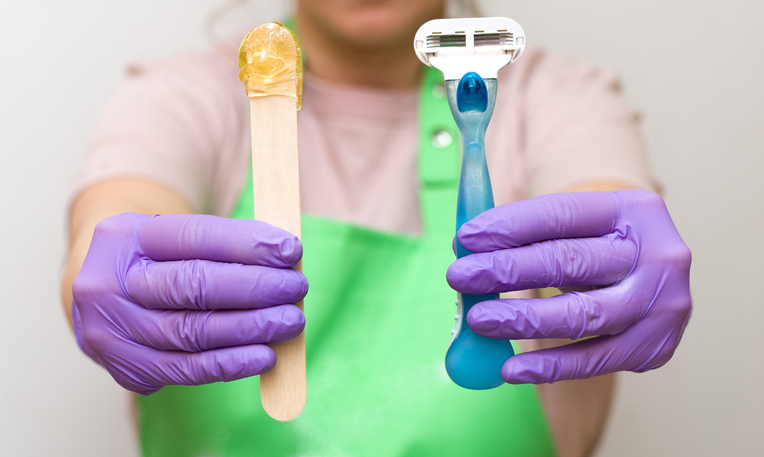
A Case for Sugaring:
As new technologies come and go, sugaring is a method people return to when they want hair removal that works with the body, not against it.
Throughout history, people have searched for hair removal methods that were effective without being extreme.
That is why older techniques like sugaring never disappeared.
Sugaring does not rely on harsh chemicals.
It does not require invasive tools.
It does not escalate risk to achieve results.
Instead, Sugaring has remained simple and adaptable.
A Very Brief History of Hair Removal
Hair removal did not start with modern razors, and it did not begin as a beauty trend.
Across cultures and centuries, people removed hair for practicality, hygiene, aesthetics, status, religion, and social norms. What has changed over time is not whether people remove hair, but how and why certain methods become common.
How Modern Hair Removal Became the Norm
Most of what we think of as normal hair removal for women is actually fairly recent.
In the United States, everyday shaving became common in the early 1900s. This shift was supported by the rise of disposable safety razors and the spread of private bathrooms, which made self shaving easier to do at home. One of the first women’s safety razors, Gillette’s Milady Décolletée, was introduced in 1915.
As fashion changed, shorter sleeves and higher hemlines meant more skin was visible, and expectations changed with it. By the mid 1960s, surveys cited in historical research show that the vast majority of American women reported shaving their legs routinely.
This matters because shaving became the default not because it was the only option, but because it was marketed as convenient and normal.
Sugaring hair removal is different. It is not a modern invention. It is a much older method that is being rediscovered by people who want hair removal that feels less reactive and more intentional.
Before Razors: Depilatories and Early Hair Removal Solutions
Before at home shaving became common, many women relied on depilatory creams and home recipes, especially for visible facial hair. In the early industrial era, some depilatories became much stronger and, in some cases, dangerous. Regulation did not keep pace with the beauty market.
In her 1899 book The Woman Beautiful, Ella Adelia Fletcher wrote that hair on the face and body was a source of extreme annoyance for women. Her suggested solutions included depilatory pomades made from quicklime, carbonate of soda, and lard. These mixtures were applied to the skin long enough to break down hair.
Other Victorian era depilatories relied on ingredients such as arsenic, quicklime, and alkaline lye. Strength was often prioritized over skin health.
This period makes one thing clear. Not all hair removal innovation was a win.
When New Hair Removal Technology Was Not Better
In the early twentieth century, there were commercial experiments with X ray hair removal. These treatments were marketed as modern and painless. They were later abandoned once the long term risks of radiation became widely understood.
This moment in hair removal history matters because it shows something important. People have always wanted hair removal to be easier, but new does not always mean better.
Why Waxing Became Mainstream
As salons expanded and beauty norms shifted, waxing became mainstream in its modern form. Later, Brazilian waxing became culturally popular, influenced by fashion, media, and changing standards of grooming.
Waxing worked well within a salon model. It relied on products that could be manufactured and sold. It could be standardized across technicians. It was fast, repeatable, and fit easily into appointment based businesses.
Sugaring, by contrast, relies heavily on hand technique and paste control. It takes longer to master and did not scale as quickly. While waxing grew because it was easier to systemize, sugaring quietly persisted in cultures and communities where technique and routine mattered more than speed.
Why Sugaring Has Lasted
Waxing grew because it scaled. Sugaring lasted because it adapted.
Sugaring did not dominate salons, but it never disappeared. It remained in use in places like family home kitchens and in communities where consistency, technique, and long term care mattered.
Today, many people are shifting away from hair removal as a rushed, last minute fix. They are returning to methods that support routine, predictability, and calm.
This is part of why sugaring is being rediscovered. Not because it is trendy, but because it fits the way many people want to care for themselves now. Safely. Consistently. Without overcomplicating it.
Why It Is Called Sugaring
The name comes directly from the paste itself.
Sugaring uses a pliable mixture made primarily from sugar, water, and an acidic element, traditionally lemon juice. The name was not created for marketing. It simply described what the method used.
In the Middle East, North Africa, and parts of the Eastern Mediterranean, the technique has long been known as halawa, a term tied to the word for sugar itself. While names vary by region, the principle remains the same. A simple paste, applied and removed by hand.
Why Sugaring Looks Different Today
Modern sugaring is performed in professional settings with updated hygiene practices, consistent paste formulas, and trained technique.
While sugaring was historically performed by hand and sometimes without gloves, today’s standards include sanitation protocols, controlled environments, and professional training that meet modern expectations for safety and cleanliness.
The technique stayed the same. The standards evolved.
Conclusion
Hair removal has never been a static practice. Across history, methods have shifted alongside culture, technology, and expectations. Some approaches were adopted because they were convenient. Others because they promised speed or permanence. Many were eventually left behind when the risks outweighed the results.
Sugaring followed a different path.
It did not evolve by becoming more extreme. It endured by staying simple. By relying on accessible ingredients, technique, and an understanding of body temperature, sugaring remained adaptable as times changed.
That is why sugaring still exists today.
Not as a trend or a shortcut, but as a method people return to when they want hair removal that feels considered, consistent, and grounded in something that has worked for a very, very long time.